Understanding Kubernetes
Kubernetes (often shortened to "k8s") is an open-source container orchestration system for automating the deployment, scaling, and management of containerized applications. It was originally developed by Google and is now maintained by the Cloud Native Computing Foundation (CNCF).
Kubernetes provides a platform-agnostic way to manage and orchestrate containers, which allows developers to deploy their applications on any infrastructure, whether it's on-premise, in the cloud, or in a hybrid environment.
It works by grouping containers into logical units called pods, which can be managed and scaled together. Pods are then organized into logical units called Services, which provide a stable endpoint for accessing the pods.
Kubernetes also provides advanced features such as automatic rollouts and rollbacks, self-healing, and horizontal scaling. It also provides a powerful and flexible API for automating and managing the entire container lifecycle.
Kubernetes is widely used in production environments, it can be run on-premises or in the cloud, it's compatible with many cloud providers such as Amazon Web Services (AWS), Google Cloud Platform (GCP), and Microsoft Azure.
Kubernetes has become a de-facto standard for container orchestration and is widely adopted in the industry for managing containerized workloads. Many companies are using it to deploy and manage their applications, and it's also being used in many enterprise-grade solutions.
The benefits:
-
Scalability: Kubernetes allows you to easily scale your applications up and down, both horizontally and vertically, to meet changing demands.
-
High availability: Kubernetes provides built-in self-healing mechanisms and automatic failover, which increases the availability and reliability of your applications.
-
Portability: Kubernetes allows you to deploy your applications on any infrastructure, whether it's on-premises, in the cloud, or in a hybrid environment.
-
Automation: Kubernetes automates many of the manual tasks involved in managing containerized applications, such as scaling, rollouts, rollbacks, and self-healing.
-
Flexibility: Kubernetes provides a powerful and flexible API that can be used to automate and manage the entire container lifecycle, as well as an extensive set of features that can be used to create custom workflows.
-
Improved security: Kubernetes provides various security features such as role-based access control (RBAC) and network segmentation to secure the containers and the cluster.
-
Resource optimization: Kubernetes allows you to optimize the use of resources by using the automatic scaling feature, which helps to adjust the resources based on the actual usage.
-
Extensibility: Kubernetes has an open-source architecture, which means that it can be easily extended and customized to meet specific needs.
-
Multi-cloud and on-premise compatibility: Kubernetes is designed to work on multiple cloud providers, as well as on-premise infrastructure, which provides more flexibility for the deployment of the applications.
-
Community Support: Kubernetes has a large and active community of developers, which can be a great help if you encounter any issues or have questions about the software.
The downsides...
-
Complexity: Kubernetes can be complex to set up and manage, especially for users who are new to container orchestration. It requires a good understanding of the underlying infrastructure and networking to configure and operate.
-
Resource requirements: Kubernetes requires a significant amount of resources to run and manage, which can be a challenge for small or resource-constrained environments.
-
Learning curve: There is a learning curve associated with Kubernetes, which can take time to master, especially for those who are new to container orchestration.
-
High maintenance: Kubernetes requires a high level of maintenance to keep it running smoothly, which can be resource-intensive.
-
Vendor lock-in: Using Kubernetes can make it difficult to switch to another container orchestration system in the future, as it requires a significant amount of work to migrate from one system to another.
-
Troubleshooting: Troubleshooting problems in a Kubernetes cluster can be difficult due to the complexity of the system. It requires a good understanding of the system internals to be able to diagnose and fix issues.
-
Security: While Kubernetes has some built-in security features, it's important to configure it properly and also keep it up to date to be able to achieve a high level of security.
-
Networking: Networking in Kubernetes can be complex and challenging, especially when it comes to service discovery and routing.
-
Cost: Running a Kubernetes cluster can be expensive, especially if you are running it on a cloud provider, as it requires a lot of resources and it's also a complex system to operate.
Kubernetes architecture
Kubernetes has a modular architecture that consists of several components that work together to provide a powerful and flexible container orchestration system.
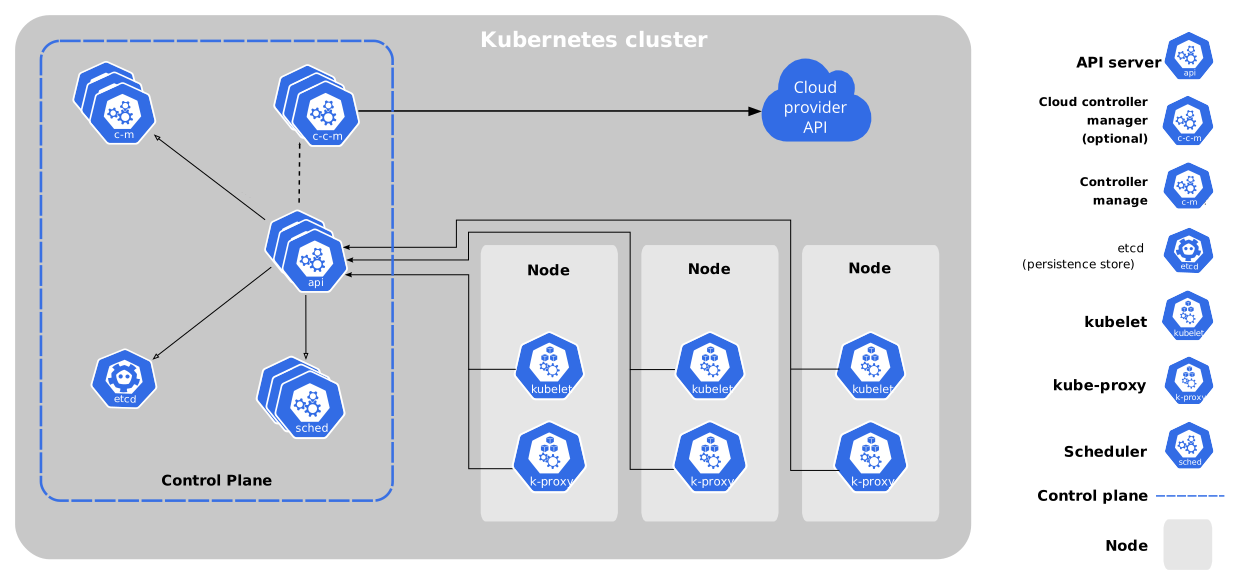
The main components of the Kubernetes architecture include:
-
The Master: The master node is responsible for managing and coordinating the entire cluster. It consists of several components, including the API server, etcd, and the controller manager.
-
The Workers: The worker nodes are responsible for running the containers and pods. They communicate with the master node to receive instructions and report the status of the pods and containers.
-
etcd: A distributed key-value store that stores the configuration data for the entire cluster.
-
The API server: The main entry point for all the operations in the cluster. It exposes a RESTful API that can be used to interact with the cluster.
-
The Scheduler: The scheduler is responsible for allocating pods to the worker nodes based on resource availability and other constraints.
-
The Kubelet: A process that runs on each worker node and communicates with the master node to ensure that the containers are running as expected.
-
The Kube-proxy: A process that runs on each worker node and manages the network connections between the pods.
-
The Container runtime: The container runtime is responsible for starting, stopping, and managing the containers.
-
The network plugin: The network plugin is responsible for providing the network connectivity between the pods.
It's worth noting that the architecture of Kubernetes is highly extensible and can be customized to suit the needs of different environments and use cases.
Kubernetes objects
Kubernetes is a complex and powerful container orchestration system, and there are several important objects and concepts to be familiar with when working with it. Some of the most important objects to know include:
Pods
- Pods are the smallest and simplest object in Kubernetes
- A pod represents a single instance of a running process in the cluster
- Pods can contain one or more containers
- Containers within a pod share the same network namespace and storage
- Pods are ephemeral and can be created, deleted, and scaled dynamically
- Pods are the atomic unit of scaling and deployment in Kubernetes
- Pods are co-located on the same node
- Pods have a unique IP address in the cluster
- Pods have a shared storage among containers
- Pods can communicate with each other using localhost
- Services are used to access pods and provide load balancing and service discovery.
A Pod is the smallest and simplest object. It represents a single instance of a running process in the cluster. Pods can contain one or more containers, and all the containers in a pod share the same network namespace and storage. Pods are ephemeral, meaning they can be created, deleted, and scaled dynamically, and they are the atomic unit of scaling and deployment in Kubernetes. Pods are co-located on the same node, have a unique IP address in the cluster, and can communicate with each other using localhost. Pods are accessed by Services, which provide load balancing and service discovery.
Services
- Services are an abstraction layer in Kubernetes that defines a set of pods and a policy for accessing them
- Services provide load balancing and service discovery
- Services allow communication between different pods
- Services provide a stable endpoint for pods
- Services use a selector to identify the pods it should route traffic to
- Services can be exposed inside or outside the cluster
- Services can be exposed using a ClusterIP, NodePort, LoadBalancer or ExternalName
- Services can be used to scale up or down the number of replicas for a Pod
- Services can be exposed using DNS and be used for service discovery
- Services can have virtual IPs that are reachable from within the cluster
- Services can have multiple ports
- Services can be updated without affecting the underlying pods.
A Service is an abstraction layer that defines a set of one or more pods and a policy for accessing them. Services provide load balancing and service discovery, allowing communication between different pods and providing a stable endpoint for pods. Services use a selector to identify the pods it should route traffic to. Services can be exposed inside or outside the cluster using various types of Service such as ClusterIP, NodePort, LoadBalancer or ExternalName. Services can also be used to scale up or down the number of replicas for a Pod and expose the service using DNS for service discovery. Services have virtual IPs that are reachable from within the cluster, can have multiple ports and can be updated without affecting the underlying pods.
Replication Controllers
- Replication Controllers (RCs) ensure that a specified number of replicas of a pod are running at any given time
- RCs are responsible for creating, scaling and deleting pods
- RCs provide automatic failover, ensuring that if a pod goes down, a new one is created
- RCs use a selector to identify the pods it should manage
- RCs can be used in conjunction with Services to provide load balancing
- RCs can be used to update the pods with zero-downtime
- RCs can be set to automatically scale the number of replicas based on resource usage
- RCs can be used to rollback an update if it causes issues
- RCs are a legacy feature and are replaced by Deployments
Replication Controllers (RCs) are a core feature of Kubernetes that ensure that a specified number of replicas of a pod are running at any given time. RCs are responsible for creating, scaling, and deleting pods as necessary to meet the desired replica count. They provide automatic failover by ensuring that if a pod goes down, a new one is created to take its place. RCs use a selector to identify the pods it should manage, and can be used in conjunction with Services to provide load balancing. They also allow for zero-downtime updates and can automatically scale the number of replicas based on resource usage. RCs can also be used to rollback an update if it causes issues. However, it's worth noting that Replication Controllers are a legacy feature and are being replaced by Deployments in Kubernetes. Deployments provide similar functionality as RCs, but with some added benefits such as being able to declaratively update and rollback pods.